The most quoted idea in Stoicism is also the easiest to misuse, and it’s possible to misuse it for years without noticing.
It comes from the first page of the Handbook of Epictetus, a former slave who taught philosophy in the first and second centuries. Some things are up to us, he says, and some are not. Up to us are our own judgements, our choices, what we aim at and what we turn away from. Not up to us are our bodies, our property, our reputations, our positions.
The usual way to read this goes: that’s not up to me, so never mind. The job, the diagnosis, the person who stopped calling. Not up to me. Next.
That is half a sentence. The Stoics were not people who sat back. Marcus Aurelius ran an empire and fought a war; Seneca wrote, advised, argued and invested. The distinction wasn’t there to excuse anyone from anything. It was there to put the effort in the right place. What is up to you, you’re responsible for completely, without excuses. What isn’t, you stop torturing yourself about, so that you have something left for the first list.
In practice, most of what keeps people awake at half past three in the morning lands awkwardly between Epictetus’ two lists. So modern writers on Stoicism often add a third. I find it works best with a pencil and three columns:
Control. Things you actually do: your actions, your words, your effort, your response once the first jolt has passed.
Influence. Things your actions affect but don’t decide: whether you get the job, what someone thinks of you, whether they forgive you.
Neither. Things that will happen whatever you do: the economy, the weather, your age, decisions made in rooms you’ll never enter.
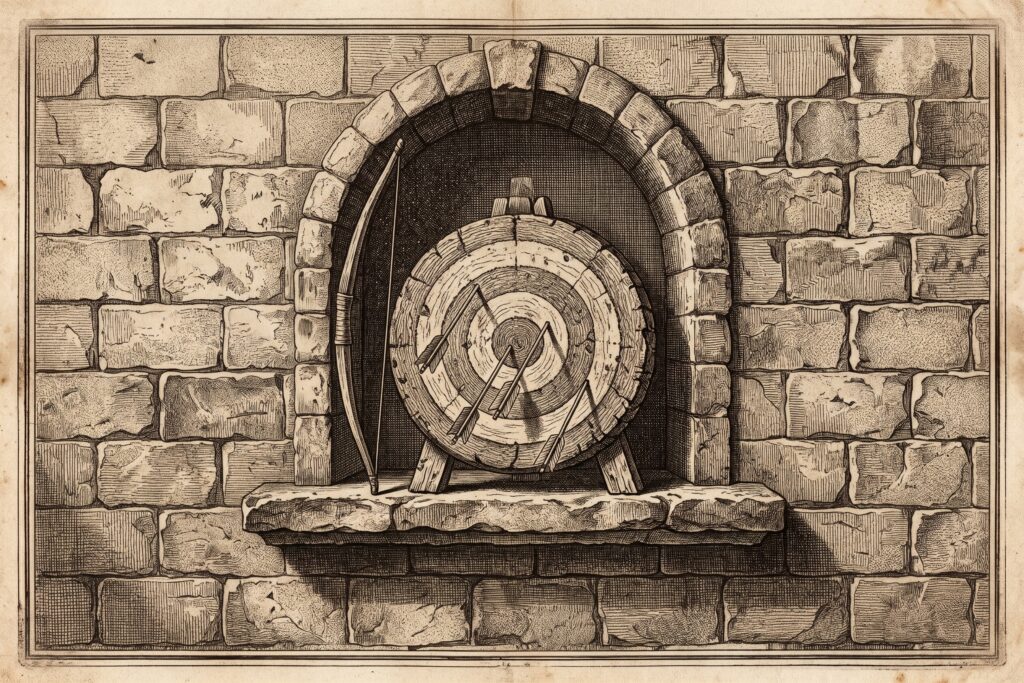
The first column says: act, fully. The third says: stop rehearsing it. The middle one is the hard one, and Cicero left a good image for it. A Stoic in one of his dialogues describes an archer, whose real aim is to do everything that makes a good shot. Hitting the target is preferred and worked for, but once the arrow leaves the bow, it isn’t his any more. Do your part completely. Hold the result loosely.
Seneca added one more tool, and it’s the only useful thing to do with the third column. Imagine the thing you fear, calmly and specifically, and ask what you would actually do if it happened. It sounds like a way to make worry worse. Often it does the opposite. Fear feeds on vagueness: what if it all goes wrong? Specifics shrink it: if I lose the job, I have this much money for this long, and I’ll do these three things. A disaster with a plan attached is still frightening. A disaster without one goes round and round all night.
Two warnings. Do the rehearsal once, on paper, and finish with what you’d do; if it turns into a loop, stop. And if what keeps coming back is harming yourself, don’t rehearse it at all. Talk to someone today. In the UK, Samaritans answer on 116 123, day and night. And if what sits in the third column is a person who frightens you, the first column has one entry before all the others: getting safe.
The columns are tidy on paper and messy in life. Your health sits partly in all three. That’s fine. The point isn’t perfect sorting. It’s to stop treating every worry as if it were equally urgent and equally yours.
Try it tonight. Rule three columns. Empty your head onto them. Then look at the first column, the one that’s easiest to leave blank, and do one thing in it tomorrow.
This note comes from Chapter 8 of ARRR, which takes the Stoics’ question and leaves the rest of their system behind.
Sources. Epictetus, Handbook (Enchiridion) §1, trans. W. A. Oldfather, Loeb Classical Library [source]. William B. Irvine, A Guide to the Good Life (2009), where the third list is called the “trichotomy of control” [interpretation]; the three columns are this note’s. Cicero, On Ends III.22, trans. H. Rackham, Loeb Classical Library [source]. Seneca, Letters 24.1–2, trans. Richard M. Gummere, Loeb Classical Library [source]; asking “what would I actually do?” is this note’s addition. Joachim Stöber and T. D. Borkovec, Cognitive Therapy and Research 26 (2002), on vagueness in worry [source]. Samaritans, samaritans.org [source].